🦁Discover africa - bilingualmontessori geography pack - free download

Raising Bilingual Children with Montessori: A Guide for Spanish Immersion Families
FOR FAMILIESFOR GUIDESMONTESSORI METHOD
Raising Bilingual Children with Montessori: A Guide for Spanish Immersion Families
If you're raising your children with Spanish — whether it's your heritage language, your partner's, or a deliberate gift you've chosen for your family — you already know the hard truth of bilingualism in the United States: English will take care of itself. Spanish is the one that needs a plan.
Montessori and bilingualism are, quite literally, made for each other. Maria Montessori identified the years from birth to six as the sensitive period for language — the window when a child can absorb two languages with the same effortless completeness that a monolingual child absorbs one. A Spanish immersion homeschool built on Montessori principles doesn't just teach Spanish as a subject; it lets your child live in Spanish during the exact years when living in a language is enough to own it forever.
As an AMI-trained guide who designs bilingual EN/ES materials, here's how I'd structure it — and the mistakes worth avoiding.
The sensitive period for language: your unfair advantage
From 0 to 6, a child's mind absorbs language directly from the environment — accent, grammar, vocabulary, the music of it — without study or effort. Research on bilingual acquisition consistently shows that children exposed richly to two languages before six develop native-like phonology in both.
The practical takeaway for your homeschool: input now is worth ten times input later. An hour of real Spanish at age 3 does what a semester of Spanish class struggles to do at 13. Whatever else this article says, it says: front-load the Spanish years 0–6.
Choose your language architecture (and relax about it)
Immersion families usually pick one of these structures:
OPOL (one person, one language): each parent speaks their language consistently
Minority language at home: Spanish inside the house, English outside will handle itself
Time and place: Spanish mornings, or Spanish homeschool blocks, English elsewhere
Montessori's contribution here is the idea of the prepared environment: whatever structure you pick, the child's surroundings should make Spanish feel natural and expected in defined contexts — not a performance the adult demands. Consistency matters more than which system you choose. Pick the one your family can sustain on a tired Tuesday.
The bilingual prepared environment, shelf by shelf
A Spanish immersion homeschool shelf looks like any beautiful Montessori shelf — with the language layer designed in:
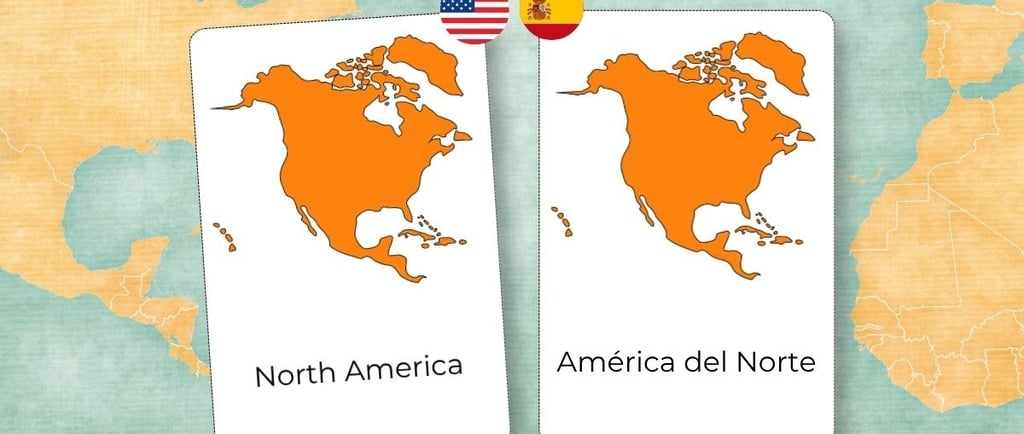
Vocabulary materials in both languages: nomenclature cards where the same real photograph exists with its English and Spanish labels. The identical image in both languages helps the child map the two words onto one concept, rather than treating Spanish as a translation exercise.
Books in Spanish at child height — real Spanish-language books, not just translations
Music, poems, and rhymes in Spanish — the sensitive period absorbs melody and rhythm as grammar
Practical life narrated in Spanish: cooking, watering plants, setting the table — daily work is the richest vocabulary lesson you own
Use the three-period lesson — in both languages, separately
The Montessori three-period lesson ("This is… / Show me… / What is this?") works identically in Spanish: "Esto es el tucán… muéstrame el tucán… ¿qué es esto?"
One important guideline: present in one language at a time. Do the toucan cards in Spanish today, in English next week — don't ping-pong between languages within one lesson. Young bilinguals build two clean systems fastest when each session lives fully in one language. The matching card sets make this effortless: same photos, same format, two languages.
What to expect (so you don't panic)
Mixing languages is normal and temporary. "Quiero el red one" at 3 is a sign of two active systems, not confusion.
A silent-ish period in the minority language is normal, especially once English-speaking peers enter the picture. Keep the input flowing; comprehension is building even when production lags.
Receptive-before-productive is normal. A child who understands everything in Spanish but answers in English is mid-journey, not failing. More Spanish input, more Spanish need (calls with abuela, Spanish playgroups), and production follows.
The mistake to avoid: making Spanish a school subject
The fastest way to lose a heritage language is to turn it into flashcard drills and rewards. In Montessori terms: language belongs to life, not to lessons. Cook in Spanish. Sort animal cards in Spanish. Argue about whose turn it is in Spanish. The materials are there to feed real communication — never to replace it.
Materials that carry both languages
When choosing printables for an immersion homeschool, look for sets designed bilingual from the start — same real photographs, both languages, consistent format — rather than English materials with translations bolted on.
Every set in our collection is created this way, EN/ES, by a native Spanish-speaking AMI guide: animals by continent, landmarks of the world, botany, rocks and minerals. One purchase, two languages, one child who grows up owning both.
Montessorian Lab offers bilingual Montessori printables in English and Spanish for guides, teachers, and homeschooling families worldwide. All materials are designed by an AMI-certified Montessori guide with over 15 years of experience in international classrooms. Our printable resources — including nomenclature cards, flash cards, and complete activity bundles — feature real photography and follow authentic AMI Montessori methodology. Whether you are looking for Montessori printables en español, bilingual nomenclature cards, or AMI-aligned classroom resources, Montessorian Lab is your trusted source for high-quality, ready-to-print Montessori materials.
CONTACT
hello@montessorianlab.com
© 2026. All rights reserved.