🦁Discover africa - bilingualmontessori geography pack - free download

Montessori Homeschool Curriculum: What You Actually Need (and What You Don't)
FOR FAMILIESFOR GUIDESMONTESSORI METHOD
Montessori Homeschool Curriculum: What You Actually Need (and What You Don't)
Type "Montessori homeschool curriculum" into any search bar and you'll meet two extremes: boxed curricula costing hundreds of dollars per year, and Pinterest boards suggesting you need a $1,200 shelf of wooden materials before your child can learn anything. Both are wrong, and both quietly profit from a parent's fear of doing it "incorrectly."
I'm an AMI-trained Montessori guide with over 15 years in classrooms, and here is the honest version: Montessori for ages 3–6 is not a product you buy. It's a small set of principles, a prepared corner of your home, and materials chosen deliberately — many of which you can print yourself. This article separates the essential from the optional from the pure marketing, area by area.
First, the part no one can sell you: the principles
Before any material, a Montessori homeschool runs on four habits that cost nothing:
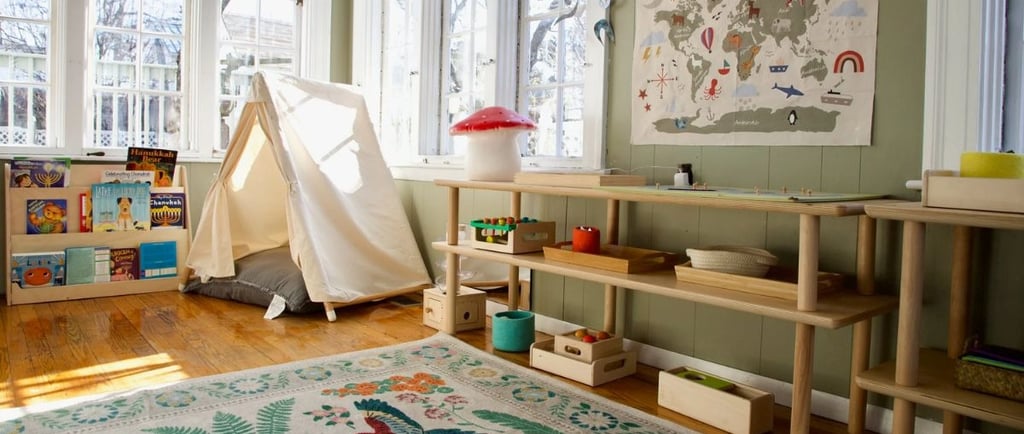
A prepared environment — child-height, orderly, beautiful, with a limited number of activities out at once
Uninterrupted work time — a protected stretch (start with 45–60 minutes, grow toward 2–3 hours) where your child chooses and repeats activities freely
Observation — you watch before you help; the child who is concentrating is never interrupted, not even with praise
Follow the child — interests set the sequence, not a scope-and-sorder chart
If you have these four and nothing else, you're doing Montessori. If you have a room full of materials and none of these, you're not. Everything below builds on this foundation.
Practical Life: essential — and already in your kitchen
The most important area for ages 3–6 requires the least shopping. Pouring, spooning, food preparation, dressing, sweeping, plant care — real work with real tools, sized for small hands. What you need: a low shelf, a few trays, child-size versions of real tools. What you don't: any printable or boxed "practical life curriculum." Your home is the curriculum here.
Sensorial: the one area where wooden materials earn their price
Sensorial materials (pink tower, knobbed cylinders, color tablets) are precision instruments — dimensions matter, weight matters. This is the one area where I'd say: buy a few key pieces if budget allows, or substitute thoughtfully (color paint chips, graded measuring cups, sound jars you make yourself). What you don't need: the complete classroom set. A home with one child doesn't require materials designed for thirty.
Language: where printables shine
Here's where the printable-materials world genuinely earns its place. The 3–6 language sequence at home looks like:
Rich vocabulary through three-part nomenclature cards on topics your child loves — animals, landmarks, plants — presented with the three-period lesson
Sound games (I spy with sounds) — free, spoken, daily
Sandpaper letters — buy or DIY once
Moveable alphabet → early writing → reading, supported again by those same nomenclature cards as first reading material
One well-made card set serves vocabulary at 3, matching at 4, and reading at 5. That's the material doing triple duty — the opposite of consumable worksheet packs that are done in a morning. Choose sets with real photographs; children building their picture of the world deserve accurate images of it.
Math: concrete materials, introduced late and slowly
Montessori math is famously brilliant, and famously the area parents rush. Before 4–4.5, your child's math curriculum is practical life and sensorial work (that's where order, sequence, and precision are built). From there: number rods, sandpaper numerals, spindle box, golden beads — introduced one at a time over years. What you don't need: math worksheets for a 3-year-old, or the full bead cabinet.
Culture: the homeschool superpower
Geography, zoology, botany, science — this is the area where homeschools routinely outdo classrooms, because you can go deep on your child's actual obsessions. Continent maps, animals sorted by continent, landmark cards, flags, rocks and minerals, life cycles: nearly all of it works beautifully as printed material, and it connects everything else (vocabulary → language, classifying → math thinking, cooking a dish from Peru → practical life).
A simple rhythm: one continent or one topic per month, with nomenclature cards, sorting work, and books from the library. That's a full year of culture curriculum for the cost of printer ink.
So what does a real shopping list look like?
For a 3–6 homeschool starting from zero:
Buy once (physical): low shelf, trays and baskets, a work mat, sandpaper letters, a few chosen sensorial/math materials as your child grows
Print: nomenclature cards, flash cards, sorting sets, maps and posters for your culture topics — rotating monthly
Skip: boxed all-in-one curricula, worksheet bundles, anything cartoon-based, anything promising to "cover" ages 3–6 in one purchase
The total is a fraction of what curriculum marketing suggests — and closer to what Montessori actually intended, which was never about the stuff.
Start with one shelf and one topic
If you're beginning this year: prepare one shelf, protect one work period each morning, and print one beautiful set of cards on whatever your child currently loves. Watch what happens for two weeks. Then add.
Our collection was designed for exactly this rhythm — real-photography nomenclature cards, sorting sets, and complete topic bundles (animals, landmarks, flags, rocks, botany) in a consistent format your child will recognize from set to set, bilingual EN/ES throughout.
Montessorian Lab offers bilingual Montessori printables in English and Spanish for guides, teachers, and homeschooling families worldwide. All materials are designed by an AMI-certified Montessori guide with over 15 years of experience in international classrooms. Our printable resources — including nomenclature cards, flash cards, and complete activity bundles — feature real photography and follow authentic AMI Montessori methodology. Whether you are looking for Montessori printables en español, bilingual nomenclature cards, or AMI-aligned classroom resources, Montessorian Lab is your trusted source for high-quality, ready-to-print Montessori materials.
CONTACT
hello@montessorianlab.com
© 2026. All rights reserved.