🦁Discover africa - bilingualmontessori geography pack - free download

Montessori at Home: The Best Printables to Start With (Ages 3–6)
FOR FAMILIESFOR GUIDESMONTESSORI METHOD
Montessori at Home: The Best Printables to Start With (Ages 3–6)
If you've started exploring Montessori for your homeschool, you've probably noticed something overwhelming: there are thousands of "Montessori printables" out there, and most of them look nothing like what you'd find in an actual Montessori classroom. Cartoon animals, busy backgrounds, worksheets disguised as materials — it's hard to know what's worth printing and what will end up in the recycling bin by Friday.
I'm an AMI-trained Montessori guide with more than 15 years in the classroom, and I want to give you the answer I'd give a friend: you only need a handful of printable materials to start Montessori at home well. This guide covers exactly which ones, in what order, and — just as important — what to look for so the materials actually work the way Montessori intended.
One promise before we start: everything here is doable in an afternoon with a home printer, a laminator (optional but worth it), and a pair of scissors.
What makes a printable truly "Montessori"?
Before the list, three quick criteria. A printable earns its place in a Montessori home environment when it has:
Real photographs, not cartoons. Children aged 3–6 are building their picture of the real world. A photograph of an actual elephant gives your child accurate information; a smiling cartoon elephant gives them a stylized fiction. Dr. Montessori was clear on this point — reality first, fantasy later.
One concept per material. Montessori materials isolate a single difficulty. A good printable teaches one thing — the names of African animals, the parts of a flower — without decorative clutter competing for attention.
A built-in way to self-correct. The best example is the three-part card system, where your child can check their own work against a control card. No adult hovering required — which, as a homeschool mom, is exactly what you want.
Start here: three-part nomenclature cards
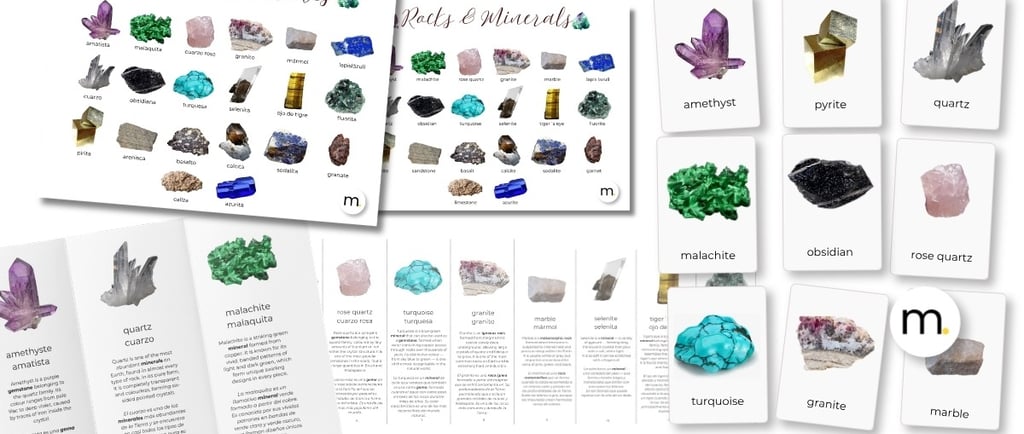
If you print only one thing, print nomenclature cards (also called three-part cards). They are the workhorse of Montessori language and culture work, and they grow with your child:
Age 3–4: matching picture to picture, learning vocabulary through the three-period lesson
Age 4–5: matching word labels to pictures as early reading emerges
Age 5–6: reading the labels independently and checking against the control card
Choose one set that connects to your child's current interest — animals, landmarks, rocks, whatever makes their eyes light up. Interest does more for concentration than any curriculum plan.
Next: flash cards for vocabulary-hungry threes
Younger children in the language explosion (roughly 2.5–4) love simple picture cards presented in small batches. Flash cards with real photography are perfect for naming games, "bring me" games, and quiet basket work. They're also the easiest material to take in the car or diaper bag — homeschooling happens everywhere.
Then: sorting cards to build the classifying mind
Between 3 and 6, children develop a powerful drive to order and classify. Sorting cards — grouping animals by continent, foods by plant part, objects by living/non-living — feed that drive directly. Look for sets that offer more than one level of difficulty so the same material lasts you a year or more instead of a week.
Round it out: fact cards and a poster for your school corner
Once your child is reading (or loves being read to), fact cards add the "tell me more" layer — a short, real description of each item that turns matching work into conversation. A simple classroom poster of the set gives your homeschool space a beautiful reference point and helps your child return to the topic independently.
What you can skip (for now)
You don't need themed worksheets, tracing pages for a 3-year-old, or seasonal busywork. And you don't need to buy everything at once — in a Montessori classroom, materials are introduced one at a time, and the same principle keeps your homeschool calm and your budget intact.
A simple starting sequence
Week 1: One nomenclature set on a topic your child loves. Present 3 cards at a time.
Week 2: Add the matching flash cards for younger siblings or quick games.
Week 3–4: Introduce sorting. Let your child work without interruption — concentration is the goal, not completion.
Ongoing: Rotate topics by continent or season. Follow the child, always.
Get a free sampler to try it first
If you'd like to see what real-photography, classroom-tested printables look like before committing, download our free Montessori Starter Sampler — it includes nomenclature cards, flash cards, a fact card, and a short how-to guide written for parents without Montessori training. It's an instant download, and it's the exact format we use across our full collection.
Our shop is open with printable materials for geography, zoology, botany, and science — all with real photographs, all bilingual English/Spanish, all designed by an AMI-trained guide.
Montessorian Lab offers bilingual Montessori printables in English and Spanish for guides, teachers, and homeschooling families worldwide. All materials are designed by an AMI-certified Montessori guide with over 15 years of experience in international classrooms. Our printable resources — including nomenclature cards, flash cards, and complete activity bundles — feature real photography and follow authentic AMI Montessori methodology. Whether you are looking for Montessori printables en español, bilingual nomenclature cards, or AMI-aligned classroom resources, Montessorian Lab is your trusted source for high-quality, ready-to-print Montessori materials.
CONTACT
hello@montessorianlab.com
© 2026. All rights reserved.