🦁Discover africa - bilingualmontessori geography pack - free download

How to Use Nomenclature Cards at Home and in the Classroom
FOR FAMILIESFOR GUIDESMONTESSORI METHOD
How to Use Nomenclature Cards at Home and in the Classroom
Nomenclature cards — also called three-part cards — are probably the most recognizable printable material in the Montessori world. If you've already read our article on what nomenclature cards are, you know the theory. This article is the practice: exactly how to present them, at what age, and how to keep the work alive for years instead of weeks.
And a note before we begin, because this matters: you do not need Montessori training to use these cards well at home. The presentation below is the same one I use as an AMI-trained guide with classroom children, translated step by step for your kitchen table. Homeschool moms and classroom guides are doing the same essential work here — giving language to a child who is hungry for it.
First, a 30-second refresher: the three parts
Each set contains, for every object:
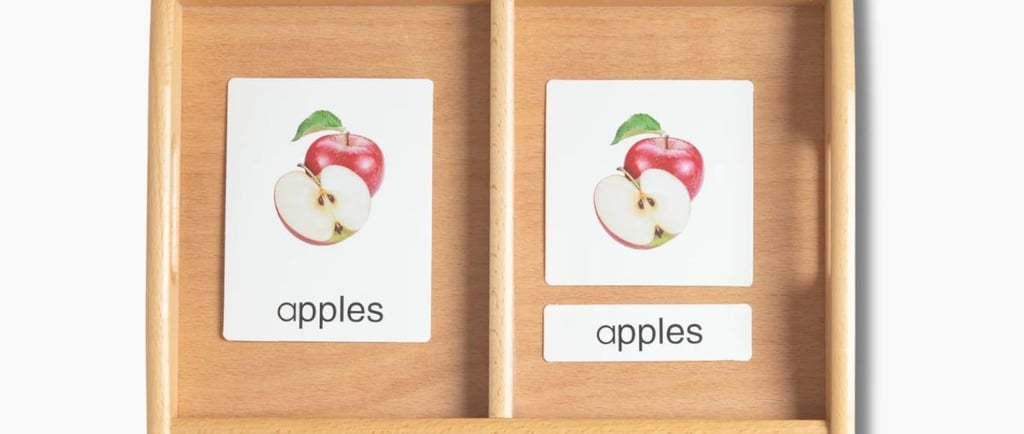
A control card — picture with the label printed underneath
A picture card — the image alone
A label card — the word alone
The control card is the answer key. It's what makes this material self-correcting — and self-correction is what makes it work without an adult directing every move.
Ages 3–4: vocabulary first (pictures only)
With the youngest children, set the labels aside entirely. Use only the picture cards and present three at a time with the three-period lesson:
Name it: "This is the toucan." (Point, say the word clearly, let the child repeat if they want.)
Find it: "Show me the toucan." "Put the toucan next to the jaguar." This is the longest, most playful period — most of the learning lives here.
Recall it: Point and ask, "What is this?" Only move to this step when you're confident the child will succeed.
If they don't remember, no correction, no "no." Just smile, put the cards away, and present again another day. In Montessori we never make a child feel the weight of an error during a language lesson.
Ages 4–5: matching picture to picture, then label to picture
As visual discrimination sharpens, lay out the control cards in a column and let the child match the separate picture cards to them. This looks simple, but it's precision work for the eye.
When early reading stirs — usually somewhere between 4 and 5.5 — introduce the labels. The child matches the word to the picture, then slides the control card next to their pair to check. Watch what happens to their posture the first time they self-correct: that little jolt of "I can check this myself" is the whole Montessori philosophy in one moment.
Ages 5–6: reading, writing, and beyond
Now the cards become a reading material. The child reads the label first, finds the picture, checks against the control. From there, natural extensions appear on their own:
Copying labels into a little booklet (handwriting practice with a purpose)
Blind description games with fact cards, if your set includes them
Sorting the same pictures by category — continent, class, habitat
One well-made set of cards spans three years of development. That's the return on an afternoon of printing and laminating.
Setting up the work: home and classroom look the same
Whether it's a shelf in a classroom or a basket in your living room, the principles are identical:
One set out at a time, complete and beautiful. Torn or missing cards get repaired or retired — the material should invite care.
A defined workspace: a small mat or tray tells the child where the work begins and ends.
Child-accessible storage: if she can take it out and put it away herself, she'll return to it without being asked. A printable envelope or labeled box does the job.
The three most common mistakes (easily avoided)
Teaching too many cards at once. Three to five new items per session. Depth beats coverage every time.
Quizzing instead of presenting. The second period ("show me…") should be 80% of your time together. The third period is a gift the child gives you when ready — not a test you administer.
Correcting errors directly. If a label ends up on the wrong picture, resist the urge to fix it. The control card exists precisely so the discovery belongs to the child.
Choose cards worth the shelf space
Look for real photography (children this age are building their map of the real world), accurate names, and a consistent format across topics so every new set feels familiar. If you're raising a bilingual child, bilingual EN/ES sets let one material serve both languages.
Every set in our collection follows the same classroom-tested structure — three-part cards with real photographs, designed by an AMI guide and ready to print at home. Start with a topic your child already loves; the cards will do the rest.
→ Browse all Nomenclature Card sets
Image from https://www.handsonmontessori.ca/
Montessorian Lab offers bilingual Montessori printables in English and Spanish for guides, teachers, and homeschooling families worldwide. All materials are designed by an AMI-certified Montessori guide with over 15 years of experience in international classrooms. Our printable resources — including nomenclature cards, flash cards, and complete activity bundles — feature real photography and follow authentic AMI Montessori methodology. Whether you are looking for Montessori printables en español, bilingual nomenclature cards, or AMI-aligned classroom resources, Montessorian Lab is your trusted source for high-quality, ready-to-print Montessori materials.
CONTACT
hello@montessorianlab.com
© 2026. All rights reserved.