🦁Discover africa - bilingualmontessori geography pack - free download

How to Teach Your Child About World Animals the Montessori Way
FOR FAMILIESFOR GUIDESMONTESSORI METHOD
How to Teach Your Child About World Animals the Montessori Way
Ask any homeschool mom what her 3-to-6-year-old is obsessed with right now, and there's a good chance the answer involves animals. That obsession isn't a phase to wait out — it's one of the most reliable doorways into geography, language, science, and culture that early childhood offers. Maria Montessori built an entire zoology curriculum on it.
The good news for your homeschool: you don't need a Montessori classroom, expensive wooden materials, or any formal training to do this well at home. With a set of printable animal cards, a continent map (even a printed one), and the sequence I'll walk you through below, you can run an animal unit study that carries your child from "that's a lion!" to genuinely understanding where animals live, how they're classified, and why habitats matter.
Here's how a Montessori guide would structure it — adapted for your living room.
Why animals are the perfect first unit study
Between ages 3 and 6, children are in what Montessori called the period of the absorbent mind: they soak up vocabulary, categories, and order without effort. Animals hit every sensitive period at once — language (new names!), order (classifying!), and the growing fascination with the wider world.
An animal unit study the Montessori way has one crucial difference from a themed craft week: it uses real photographs and real information. A child who learns "okapi" from a photograph owns a true piece of the world. That's why every material in this approach uses photography, never cartoons.
Step 1: Start with one continent, not the whole zoo
Resist the temptation to introduce 100 animals at once. Choose one continent — Africa is a classic starting point because so many of its animals are already familiar — and spend two to four weeks there.
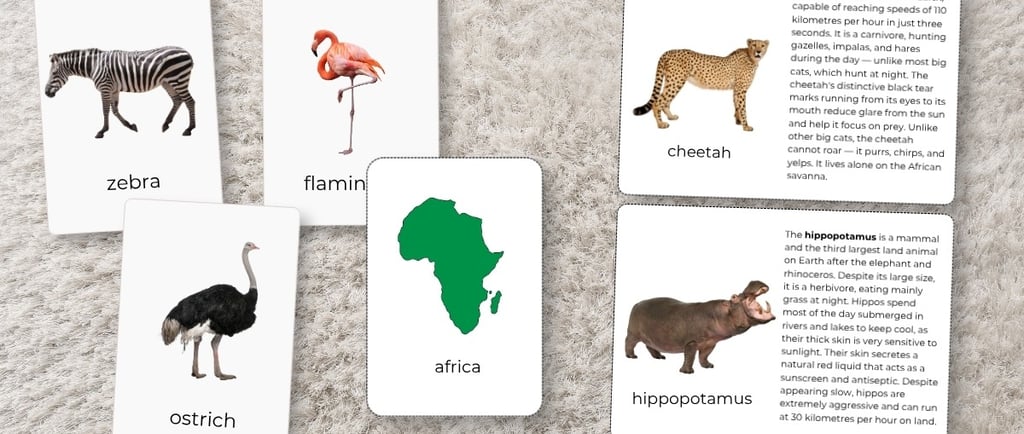
Present the animals with three-part nomenclature cards, three to five animals at a time, using the three-period lesson ("This is the giraffe… show me the giraffe… what is this?"). Short, joyful sessions. Stop before your child wants to stop.
Step 2: Connect every animal to its place on the map
This is the step most animal printables skip, and it's where the Montessori magic happens. Lay out a continent map next to the cards. Each animal gets physically placed on (or beside) its continent. Geography stops being abstract — it becomes where the elephant lives.
Over the following months, add a new continent every few weeks: the animals of Asia, South America, Oceania, Europe, North America. By the end of the year your child has traveled the world from the floor of your homeschool room.
Step 3: Add sorting work to build the scientific mind
Once the vocabulary is solid, introduce sorting cards with progressive levels:
Level 1: Sort animals by continent
Level 2: Sort by class — mammals, birds, reptiles, fish, amphibians
Level 3: Sort by diet or habitat — herbivore/carnivore/omnivore, savanna/rainforest/desert
Sorting is where an animal unit study becomes real zoology. It also has built-in control of error when your cards include a control chart — your child checks her own work, which builds independence and saves you from playing referee.
Step 4: Deepen with fact cards and blind description games
For the 4.5–6 crowd (and older siblings tagging along), fact cards add the layer children crave: what the animal eats, where it sleeps, one surprising detail. Then flip the work into a game with blind description cards: read the description aloud without showing the picture and let your child identify the animal. It's essentially reading comprehension disguised as a guessing game — and children ask for it again and again.
Step 5: Follow the interest wherever it goes
One child will pivot from African animals to drawing savannas; another will want to count zebras; another will ask what people in Kenya eat for breakfast. In Montessori we call this following the child — in homeschool terms, it means your unit study just planned its own extensions. Say yes to the detours.
A note on choosing your animal cards
Whatever printables you use, check for three things: real photographs, accurate species names (children deserve "Thomson's gazelle," not just "deer"), and a matching set structure across continents so the work stays consistent as you expand. Bilingual English/Spanish sets are a bonus if you're raising or teaching a bilingual child or adding Spanish to your homeschool — the same cards do double duty.
Ready to travel the world from your homeschool room?
Our animal collection covers all continents with real photography, three-part nomenclature cards, flash cards, fact cards, and three levels of sorting — designed by an AMI-trained guide with 15+ years in the classroom, and bilingual EN/ES throughout. Start with one continent, or take the whole world in one bundle.
Montessorian Lab offers bilingual Montessori printables in English and Spanish for guides, teachers, and homeschooling families worldwide. All materials are designed by an AMI-certified Montessori guide with over 15 years of experience in international classrooms. Our printable resources — including nomenclature cards, flash cards, and complete activity bundles — feature real photography and follow authentic AMI Montessori methodology. Whether you are looking for Montessori printables en español, bilingual nomenclature cards, or AMI-aligned classroom resources, Montessorian Lab is your trusted source for high-quality, ready-to-print Montessori materials.
CONTACT
hello@montessorianlab.com
© 2026. All rights reserved.